After #MeToo, Hollywood women seize power behind TV camera
|Published
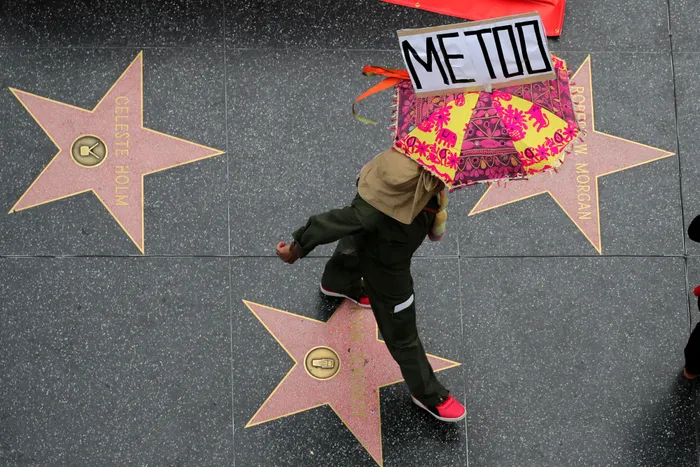
HOLLYWOOD: A demonstrator takes part in a #MeToo protest march for survivors of sexual assault and their supporters in Hollywood. Photo: LUCY NICHOLSON/ REUTERS HOLLYWOOD: A demonstrator takes part in a #MeToo protest march for survivors of sexual assault and their supporters in Hollywood. Photo: LUCY NICHOLSON/ REUTERS
When writer and producer
Stacy Rukeyser suggested featuring a female venture capitalist
looking for a husband on the Lifetime television drama " Unreal,"
network executives asked if she could turn the character into
someone with "a much more traditional, demure sense of
femininity."
"I got the request 'do you think we could change it? Maybe
she could be a kindergarten teacher,'" Rukeyser said at a recent
Producers Guild of America conference.
She resisted and she prevailed. Like her, an increasing
number of women in Hollywood, boosted by the #MeToo movement,
are starting to exert influence behind the TV camera and to
break on-screen stereotypes.
Nearly a year into the #MeToo movement, networks are
mandating women in the director's chair, studios are running
mentoring programs, and actresses are insisting on producing
roles to have more control, according to early evidence and
interviews with more than a dozen industry players.
"We are amplifying the voices that have never been allowed
to soar in our culture," said Melissa Silverstein, founder and
publisher of the Women and Hollywood blog. "That is going to
make our culture, our TV shows, our movies, better and stronger
and more relevant."
#MeToo and the Time's Up campaign emerged in response to
accusations of sexual harassment and abuse by powerful men in
Hollywood starting last October. But it also spotlighted the
lack of women shaping female characters and storylines.
To help change that, Susanne Daniels, global head of
original programming at Alphabet Inc's YouTube, told
Reuters she requires that all of the platform's original series
employ some female directors each season.
In the past, she had to fight, calling and demanding that
producers hire female directors, often meeting resistance. Since
the #MeToo movement began, they have been more receptive.
"I'm finding I have to fight a little less hard," she said.
Producers often argue that there are too few experienced
female directors to choose from. Comcast Corp's NBC
moved to increase the talent pool with "Female Forward," an
initiative that lets women shadow a director of an NBC show and
direct at least one episode.
There is early evidence that the gender diversity push is
making a difference. Fourteen of 42 drama show pilots ordered by
broadcast networks in the spring were directed by women, up from
just one last year, according to trade publication Deadline
Hollywood.
And producers are seeing interest in more complex female
characters, with writers relishing the freedom to depict women
outside stereotypes, said Nina Tassler, the former head of CBS
Entertainment who started a production company aimed at telling
stories from diverse voices.
"Having a great female villain is as interesting and as
important as having a heroine," she said.
Still, consensus is that Hollywood has a long way to go.
In the 2016-17 TV season, women filled just 28 percent of
behind-the-scenes roles such as creators, directors, writers and
producers, according to San Diego State University's Center for
the Study of Women in Television and Film. Forty-two percent of
speaking roles were female.
Both figures are roughly unchanged from four years earlier.
Full data on the upcoming fall season are not yet available.
Actress Alison Brie, who stars on Netflix Inc
comedy " Glow" about a group of women wrestlers, said it is
refreshing to work on a show with two female showrunners,
several female directors, and a cast of diverse women and
multi-dimensional characters.
But when she's not filming " Glow," the Golden
Globe-nominated actress finds the range of available roles
disappointing.
"A lot of the characters I read are unflawed, really
likeable gals, with lots of gumption," Brie said at a Netflix
event. "They really want a man in their lives, and that's their
biggest goal."
Brie said she is responding by joining future projects early
in development and asking to work as a producer, a role that
typically affords more creative input.
"In theory, it will empower me to make sure the characters
I'm playing are a bit more well-rounded and compelling," she
said.
Rukeyser said Lifetime executives came to embrace her vision
for the feminist character on " Unreal." A Lifetime
representative did not respond to a request for comment.
She also told Reuters that she and others are promoting the
social media hashtag #ShowUsYourRoom, in a push to provide
visual proof of diversity in writers rooms.
Although too early to declare victory, she has seen the
beginning of change.
"I have pitched shows in the past where executives will say
'it's too female,'" she said. "I don't know that any one of them
would have the guts to say that today."