Residents angered by sewage build-up
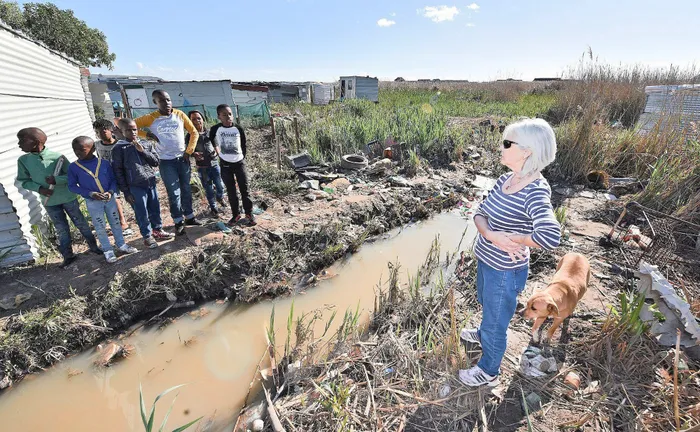
UNHYGIENIC: The sewage problem in Masiphumelele continues despite calls from the community to the City to clean up the waterways which are blocked by reeds, thus trapping human effluent. Community activist Rosemary Milbank speaks to local children at the end of the canal where it is blocked. Picture: Jason Boud UNHYGIENIC: The sewage problem in Masiphumelele continues despite calls from the community to the City to clean up the waterways which are blocked by reeds, thus trapping human effluent. Community activist Rosemary Milbank speaks to local children at the end of the canal where it is blocked. Picture: Jason Boud
THE CITY of Cape Town received two directives, instructing them to clean the canals in Masiphumelele near Noordhoek. This followed a meeting with the mayor of Cape Town, Patricia de Lille, in which the public protector, Busisiwe Mkhwebane, also requested the City to come up with a plan to clean the area.
This is according to Rose Milband, a Masiphumelele community worker. The City confirmed that it met the public protector earlier this month. Zara Nicholson, spokesperson for De Lille, said that the public protector was provided with a progress report on all the work the City is doing in Masiphumelele and how they plan to bring further improvements.
“Both the mayor and the public protector agreed on the way forward and to work together in the interest of improving the living conditions of the people of Masiphumelele. Our offices are working on a plan for the area and a follow-up meeting is being scheduled where the mayor will provide further updates to the public protector on the plans for the area,” Nicholson said.
Residents in Masiphumelele are up in arms about the sewage-filled canals and the portable flush toilets which were recently delivered to the community. In a letter Xanthea Limberg, mayoral committee member for informal settlements, water and waste services and energy, said that the City had increased cleansing and maintenance functions in the area.
“Cleaning of the stormwater canals is happening on an almost daily basis, and the City has increased door-to-door refuse collection services to seven days a week. Some residents are, however, still using the canals as a general dump-site for food waste and other refuse, which causes cleanliness to deteriorate rapidly. Furthermore, the City is also undertaking a pilot project to divert stormwater from these canals into the sewerage system.”
Milband said that it is not true that the canals are cleaned almost every day. “If these canals were cleaned every day then there would not be sewerage in it. There are 264 toilets for 15000 people. There are plenty of places to install more toilets. The City is refusing point blank to clean, repair or replace broken toilets,” she said.
Limberg said there is “no perfect solution for the challenges faced in Masiphumelele, but the City is doing everything it can to address the effects of overcrowding. We need residents to understand that the provision of alternative sanitation does not mean we are not prioritising them. It is rather the case that this is the only safe and legal option available and one of the few means we have available to improve conditions".
In response, Milband said that that portable toilets “is the most undignified thing. Are people supposed to use these pota-potas in front of each other in their tiny shacks? It is untrue that the community were consulted about the portable toilets. They just brought the stuff to the community. People were expecting flush toilets,” she said.
Dumisani Nhlapo, a community worker in Masiphumelele, added that the community does not want the portable toilets.