WCED in race to find schools for thousands of unplaced Cape learners
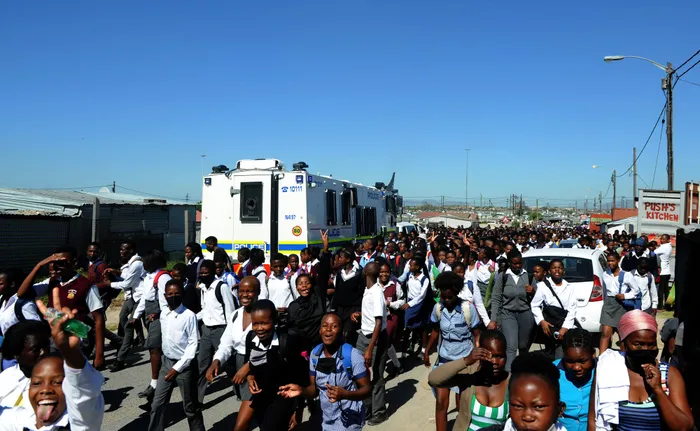
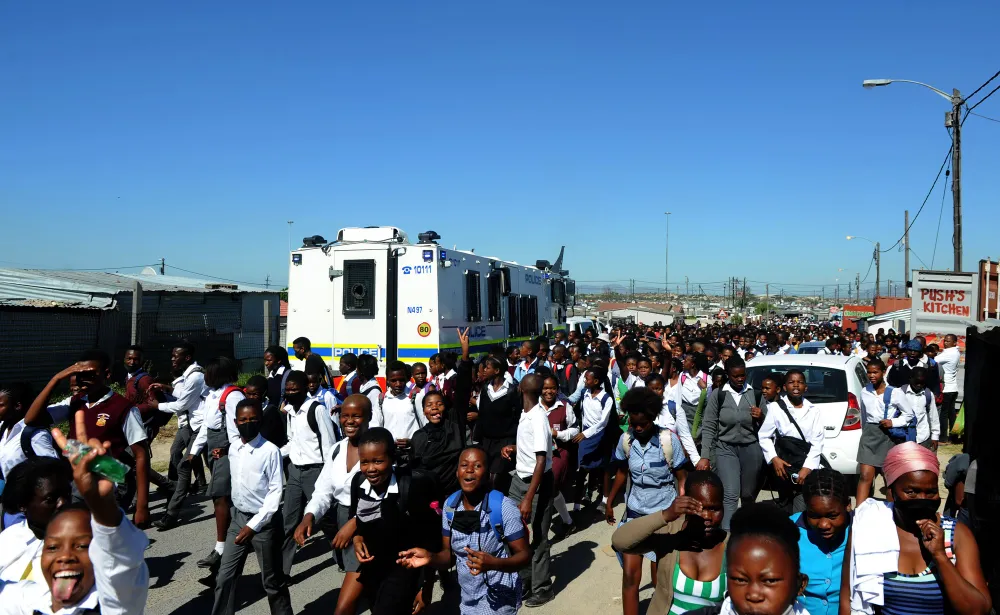
Over 1000 unplaced school children from Mfuleni march demanding to be placed. Photographer Ayanda Ndamane African News Agency (ANA)
Fifteen-year-old Sethu Luphuwana is one of 6 400 unplaced pupils the provincial education department is scrambling to find space for.
Tomorrow will mark a full month since the academic year began for many public school pupils but thousands are without placements in areas such as Mitchell’s Plain, Eerste River, Strand, Du Noon, Mfuleni, Khayelitsha, Vredenburg, Mossel Bay, Hermanus and Grabouw.
The Western Cape Education Department (WCED) said to keep up with new enrolments that have averaged around 20 000 new pupils each year, they would have a backlog of 140 schools, as they would have needed to build at least 20 schools a year to accommodate the growth.
The latest enrolment figures mean the department will be sitting with similar challenges come next year.
For 2022, the department has already received 180 000 applications from more than 54 000 registered parents.
Over 17 000 of these parents applied for Grade R while 15 000 applied for Grade 8 and 9 500 parents applied for Grade 1.
With this year’s enrolment figures estimated to be at 1 096 605, the department’s schools have 1 229 988 places, even though the available spaces are often not in high-demand areas. This figure might also increase as the WCED adds more classrooms and newly-built schools online for the coming year.
Department spokesperson Bronagh Hammond says the WCED currently has seven upgrades or new constructions for schools that are due for completion by the end of this year and would be available for the 2022 school year.
Responding to questions during a meeting of the provincial legislature’s standing committee on education, the department’s Leslie McGlen said plans for new schools are always in hotspot areas but a lack of land is a major problem.
“We build schools but we cannot keep up with the backlogs. An average of in excess of 20 000 (new) learners per year (come into the system) but we cannot build 20 schools the budget does not allow. We have to maintain (the growth) with the 1 500 schools we do have,” she said.
“We cannot accommodate the influx each year. If the numbers were constant, we would have a fighting chance to plan infrastructure that could support all the learners. It’s more than five years now that we have had an influx of around 20 000 and we haven’t provided 20 schools a year, so there is a backlog of more than 140 new schools and then there are the replacement schools which also sits elsewhere.”
Hammond said new enrolments for the current year from other provinces stand at over 19 000, with more than 15 000 of applicants being from the Eastern Cape. This means preliminary figures of enrolled pupils stands at 1 096 605 in the Western Cape.
“To keep up with this demand alone, we would need to build 19 new schools every year. In addition we would have to employ an additional 525 educators to accommodate this growth,” she said.
“We have been open and honest in the past few years that we cannot sustain this growth with the budget allocations we have been given.”
Sibulelo Magodla’s nephew, Sethu Luphuwana, is such an applicant whose mother sent him to live in Philippi with his uncle.
“We applied to three different primary schools in the area for grade six and all said they were full,” said Magodla.
“It’s been weeks with him just sitting at home and no word from the schools or the department about possible spaces opening up. At this rate he may just have to return to Gqeberha (Port Elizabeth) and hope he can get back into his old school. The concern was that his mother works and there is no one to monitor and ensure that he actually goes to school like he is meant to.”
Weekend Argus