Sir Lowry’s Pass farmers kwaad
Mense claim intimidation after pigs are seized
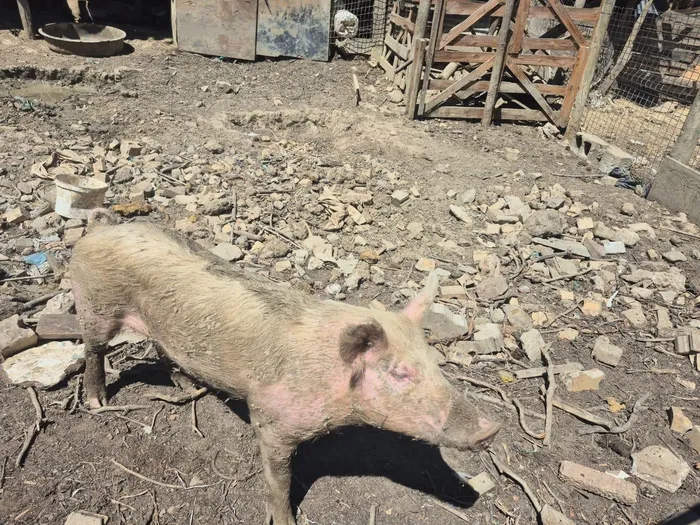
Families devastated as SPCA seizes 96 pigs in Sir Lowry’s Pass amid claims of unlawful action and worsening animal suffering.
Image: Supplied/ SPCA
Families in Sir Lowry’s Pass say they have been left without livestock they depend on for their livelihood after the Cape of Good Hope SPCA, supported by SAPS and the City’s Animal Control Unit, seized 96 pigs from a property.
The SPCA says the removal followed months of unsuccessful attempts to improve animal-welfare conditions, while community representatives allege the operation was unlawful and harmful to small-scale farmers.
The SPCA said inspectors found pigs living in “filthy, unhygienic, and wholly unacceptable” conditions last week despite repeated efforts to assist the owners since May.
Inspector Lwazi Ntungele said: “When it rains, the pigs were stranded in mud and their own excrement, without access to clean water. When it’s hot, we find them with no water at all and still living in filth. Some animals were suffering from untreated medical conditions.” He said these were “direct contraventions of the law.”
The organisation said it obtained a warrant under the Animals Protection Act 71 of 1962, adding that the seizure was carried out “in full compliance with the law” under supervision of SAPS, the City’s Animal Control Unit and Public Order Police. Inspector Rudolph Philander said: “Our mandate is to protect animals from suffering… Confiscation is always a last resort.”
Community representative Christiaan Stewart, who holds power of attorney for the property owner, disputes the legality of the operation. “The SPCA, SAPS, and Law Enforcement took pigs from farmers without a court order. This is not legal enforcement. It is intimidation,” he wrote, adding: “Families who have lived and worked here for years are now at risk of losing everything.” Stewart claims the seizure forms part of “a deliberate effort to make life impossible for small-scale farmers and take their land,” allegations that have not been substantiated.
Ward Councillor Norman McFarlane, however, said he was informed of the planned operation the day before and that it was an SPCA operation conducted under a court order, after multiple engagements by SPCA with the animal owners about the condition and circumstances of the 96 pigs that were seized.
McFarlane said he was asked to attend to engage with the community, which he did, but emphasised that the operation was not conducted by the City of Cape Town, but by the SPCA under a court order.
He acknowledged the impact on households, saying: “Of course, I am concerned about the impact that this has had on the affected families, but the matter is beyond my control as it is not a City of Cape Town operation.” He added that “the presence of the pigs there is an offence, since the land is not zoned agricultural. Secondly, the land belongs to Transnet, so City does not have jurisdiction.”
He said there is an ongoing court case, about relocation of the pigs to suitable land, noting that a possible erf for relocation would require rezoning and denied claims that he should have warned residents beforehand.
“The expectation that I ought to have warned the animal owners of the imminent operation is ridiculous… I would have been charged for interfering with a court order, and I would have been dismissed from my position as a councillor.”
Chief Inspector Jaco Pieterse dismissed Stewart’s claims, writing that the seizure “was effected under criminal legislation and a warrant issued by the Magistrates’ Court and that Stewart has no legal standing to compel engagement, nor to insert yourself into a criminal matter.
The pigs remain in SPCA care as the criminal investigation continues. Stewart maintains that affected families still need answers from authorities.