Ramaphosa rejects Western Cape secession referendum
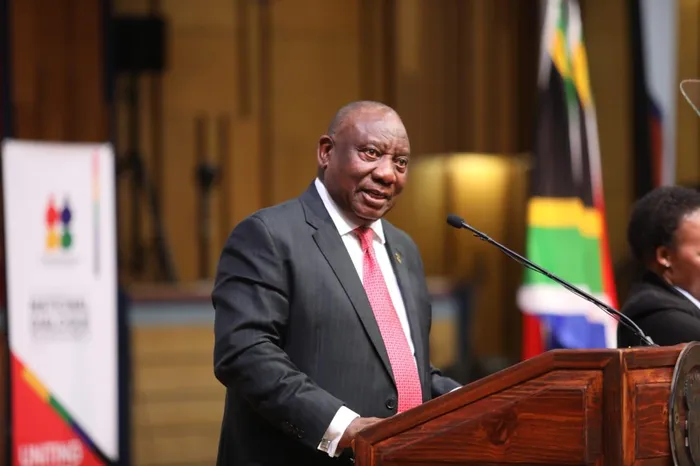
President Cyril Ramaphosa is not considering referendum to decide on secession of any part of South Africa.
Image: Oupa Mokoena / Independent Newspapers
PRESIDENT Cyril Ramaphosa has given a clearest indication that he has no intention of holding a referendum to test public opinion for secession of any part of South Africa.
“The founding provisions of our Constitution state that the Republic of South Africa is one, sovereign, democratic state,” Ramaphosa said.
He made the statement while responding to parliamentary questions from EFF MP Thapelo Mogale, who asked whether he intends holding a referendum to test public opinion for or against secession of the Western Cape, the creation of a Volkstaat for Afrikaners and Western Cape independence.
In his response, Ramaphosa said the Constitution obliged him to defend the supreme law of the country and promote unity of the nation.
“In line with the constitutional responsibility of the president to uphold, defend, and respect the Constitution as the supreme law of the Republic and to promote the unity of the nation, I have no intention of considering a proposal or holding a referendum on the secession of any part of the country,” he said.
Ramaphosa also stated that he has not been lobbied by any component of the Government of National Unity on the matter.
Responding to EFF leader Julius Malema, Ramaphosa said there are 43 deputy ministers appointed in terms of Section 93 of the Constitution in the Government of National Unity. “As required by Section 93 of the Constitution, the deputy ministers are appointed to assist the ministers,” he said.
Malema wanted clarity on whether deputy ministers were assigned delegated authority and signed performance agreements.
He also asked about consequence management measures that have been implemented for ministers who have not delegated official duties in writing to their deputy ministers.
This came hot on the heels of evidence given at the Ad Hoc Committee where Deputy Ministers Cassel Mathale and Polly Boshielo revealed that they were not assigned functions by suspended Police Minister Senzo Mchunu.
The revelation re-ignited the ongoing debate on whether there is a need for deputy ministers and monies used to pay for their remuneration, allowances, and benefits.
ActionSA has even tabled a Private Member’s Bill in Parliament, calling for the scrapping of deputy ministers in the executive.
Ramaphosa said he has signed performance agreements with ministers.
“The performance agreements signed between the president and the ministers contain an indicator that requires the delegation of responsibilities by the minister to the deputy minister and signed delegations are used as evidence of completion.”
He also said the delegations to the deputy ministers were the responsibility of ministers.
Ramaphosa also said the delegation of responsibilities was one of the indicators in ministers’ performance agreements.
“Ministers will be held responsible for this during performance review engagements held with the president. It is the president’s prerogative to determine the appropriate sanction for ministers.”
Ramaphosa added that the breakdown of deputy ministers’ travel and related costs would be reflected in the budgets of the relevant departments.
In another development, Ramaphosa would not mention nor say how many members of the Cabinet hold dual citizenship.
He said there was no record kept of members of Cabinet who hold dual citizenship as the issue of dual citizenship does not play a role in the appointment of members of Cabinet.
“According to Section 47(1) of the Constitution, every citizen of the Republic of South Africa, who is qualified to vote for the National Assembly, and who is not disqualified by the Constitution, can be a member of the National Assembly and by extension can be appointed as a minister.”
Responding to Mogale, Ramaphosa explained that the Constitution does not require that members of the Cabinet should be vetted before they are appointed by the president.
He further stated that the Constitution provides for the president to appoint ministers from the members of the National Assembly and not more than two persons outside from the National Assembly.
“Section 47(1) of Constitution goes further and provides that every citizen of the Republic of South Africa who is eligible to be a member of the National Assembly, and if he or she is not disqualified by the Constitution, can be a member of the National Assembly and in extension that person can also be appointed as a minister.
“The Constitution does not require members of Cabinet to be vetted and cleared by the State Security Agency before they are appointed by the president.”
Ramaphosa added that all ministers who are currently serving in the Cabinet qualified to be ministers according to the Constitution.