MALEMA REJECTS RULING
EFF leader says his statement wasn’t literal instructions to kill white people
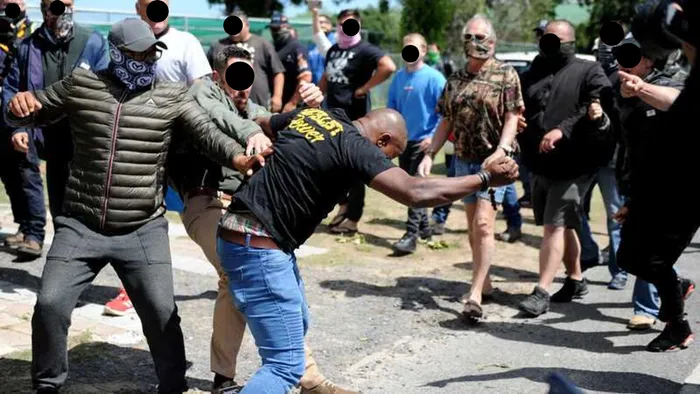
Fighting broke out between EFF and Brackenfell residents after a hostile stand-off at Brackenfell High School in 2020.
Image: Ayanda Ndamane / Independent Newspapers
EFF President Julius Malema has rejected Wednesday’s Equality Court ruling that found his statements constituted hate speech and incitement to violence, labelling the judgment a “the nature of political speech in a democratic society”.
The ruling by the Western Cape Division of the Equality Court upheld claims by the South African Human Rights Commission (SAHRC) and Dante van Wyk against Malema and the EFF.
The SAHRC initiated the litigation in November 2022 following public complaints about comments Malema made at a political gathering in Cape Town in October 2022.
The court specifically cited Malema’s remarks in which he challenged the white race and threatened to kill.
“You must never be scared to kill. A revolution demands that, at some point, there must be killing. This is a war between white supremacy and black consciousness, you must know the two will never meet,” and “Racism is violence and violence can only be ended by violence,” Malema said at the time.
The court found these statements could “reasonably be construed as demonstrating a clear intention to incite harm” and violated Section 10 of the Equality Act.
Malema, however, argued that the court’s conclusion is “fundamentally flawed and deliberately misreads both the context and the meaning of the speech”.
He asserted that the court interpreted his statements as “literal instructions to kill white people”, stripping the speech of its “political, historical, and ideological context, reducing a revolutionary critique to criminality”.
“It assumes that the reasonable listener is incapable of understanding metaphor, revolutionary rhetoric, or the history of liberation struggles,” Malema said.
He added that the court ignored the nature of the occasion, which was a political assembly where revolutionary theory, strategy, and history are discussed, and treated the speech as if it were a direct operational command to commit murder.
Malema highlighted three “critical realities” he believes the court ignored.
He explained that his remarks followed an incident where white racists assaulted black protesters at the Brackenfell High School incident. His comments emphasised that “racism itself was violence and could not be passively endured”.
Malema stressed that South Africa was built on structural and physical violence against black people, and the anti-apartheid struggle included armed resistance as “the system left no alternative”.
He further explained that as a Marxist-Leninist and Fanonian movement, the EFF's analysis recognises class and racial contradictions.
“When I spoke of 'war', it was a reference to the irreconcilable conflict between white supremacy and black consciousness – a war of ideas and systems, not an instruction to kill white people,” he said.
In a statement, the party announced its intention to challenge the ruling at the Supreme Court of Appeal, saying it would not only defend Malema, but also defend political freedom.
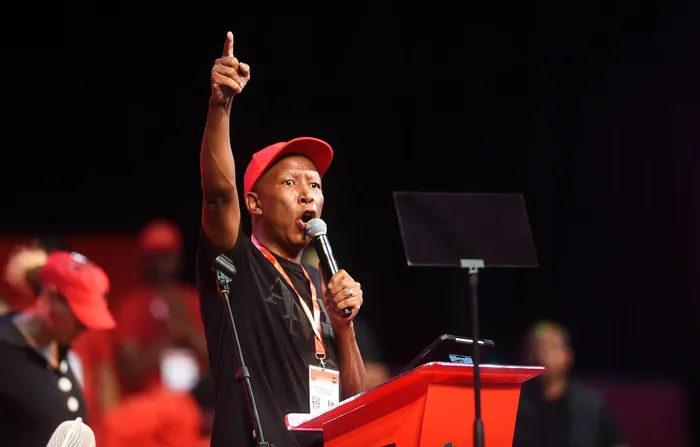
STAAN VAS: Julius Malema
Image: Itumeleng English / Independent Newspapers