DALA FLATS - Communities and experts back City's call for policing powers

Acting Police Minister Firoz Cachalia delivers the much-anticipated quarterly crime statistics recorded during the first and second quarters of the current financial year, which spans from April to September 2025.
Image: Itumeleng English/ Independent Newspapers
VIOLENT crime is rising again on the Cape Flats according to shocking new crime statistics and mense innie Kaap are demanding government takes action.
An alarming jump of nine percent in the murder rate in the Western Cape and a shocking 91 percent of gang-related crimes in South Africa during the first half of the financial year have residents living in constant fear.
Several Cape Flats hotspots recorded spikes in murder, attempted murder and extortion-linked cases, with police stations like Nyanga, Delft, Mitchells Plain and Khayelitsha once again appearing in the country’s top 30.
And while the City of Cape Town and Western Cape Government believe devolving policing powers to local authorities could help curb the crisis, national government has yet to act.
Residents say nothing has changed as response times are slow, detectives are overloaded, and visible policing is inconsistent.
In Delft, the station recorded a 13.2 percent increase in crime detection as a result of police action from July 2025 to September 2025 compared to July 2024 to September 2024.
Wesbank Community Policing Forum (CPF) spokesperson Mvano Magula said: “There is a lot happening in Wesbank and we seek help, be it from government or spiritual intervention.”
The area which falls under Delft is among the province’s worst-performing stations, yet policing resources remain thin and visible patrols inconsistent. A promised mobile police station is only expected to arrive in December.
Magula added: “We appreciate what the City is trying to do, but five Metro officers are not enough to deal with the current situation.”
While residents face these daily dangers, the City argues it could do more if granted additional powers to fight crime on the ground.
The City wants investigative powers for gang violence, firearm offences, extortion and drug trafficking, as well as the authority to run crime intelligence and forensic firearm-testing facilities, all functions currently controlled by the South African Police Service (SAPS).
The City argues that its officers already support SAPS heavily on the ground, especially through the Law Enforcement Advancement Programme (LEAP), but remain blocked from doing more.
In a parliamentary question, DA MP Nicholas Gotsell last week pressed Deputy President Paul Mashatile on why the national executive had not taken up the City’s proposal.
Gotsell said: “Over 400 people were murdered in the Western Cape in October, [two weeks ago] 39 people were murdered on the Cape Flats; yet, the government still refuses to expand policing powers to enable the City’s offer to deploy Metro Police to help SAPS with investigative and intelligence capacity in the City.
“Your government is turning away real help while communities are being slaughtered. What does that say about your commitment to fixing the systemic failures which you speak of?”
Mashatile vowed to engage with the National Joint Operational and Intelligence Structure (NatJoints) to explore tapping into the City of Cape Town’s intelligence capability to strengthen the fight against gang violence.
He said: “If the Western Cape or the City of Cape Town has got capability to work with NatJoints, I am sure they won't chase you away. I will engage with them because surely that resource is needed, but of course, you know, there are protocols.”
He added: “The strategy will ensure that gangs and criminal networks are investigated, neutralised and dismantled.”
Even with government assurances, criminologists warn that structural issues in SAPS hinder effective policing.
Criminologist expert Dr Jean Redpath said that the biggest structural reasons for SAPS struggles to police areas like the Cape Flats effectively is due to the formula to allocate police resources,
Redpath explained: “What that formula ends up doing is that areas like Khayelitsha, Harare, Mitchells Plain actually get fewer resources per person than more formal areas. That is because those areas have relatively low reporting rates of crime.
“Instead of 80 or 90 percent of people reporting crime, 30 to 40 percent report crime. The crime data is used in the formula to allocate resources. So if an area has a low reporting rate, then it’s actually going to end up with low resources on a per person basis.”
She added that this has been seen within the Khayelitsha commission and Harare had the lowest allocation of resources of any police station in the Western Cape at the time.
Adjustments have been made to the formula following a court case, however Redpath said that it is still not enough to address the nature and type of crimes that occur on the Cape Flats.
She added that following the stats being released, most areas innie Kaap have had an increase in murders, however areas where LEAP officers are deployed were somewhat better off.
Redpath said: “That could be so much better if there was good cooperation between SAPS and LEAP officers, but SAPS is not using the LEAP officers and the resources of the metro police.
“They are not using them and properly working together with them. Another key problem is that those LEAP officers are seizing a lot of firearms which is a good thing. But those cases of people who had the firearms are simply not being prosecuted.”
She added that these cases often see excuses such as SAPS not doing the ballistics or other delays, but she believes that much more can be done to boost the process.
Furthermore, some attention should go to the prosecuting authority as it is of no use if SAPS make arrests if they are not convicted or have a criminal record.
Redpath added: “The whole system needs to improve and they really need to focus on firearms offences, preventative things, like dangerous weapons in public spaces who tend not to be prosecuted due to problems such as proving that it is a firearm.
“These things require applying the mind and trying to solve the problem which is not being done.
“Communities must ask that consequences follow when the police mess up or when they are not doing what they should be doing. If someone is incapable in their job, they should be incapacitated out of the job.”
As crime rises and the festive season looms, Flats mense remain caught between overstretched policing, national red tape, and the City’s push for devolution leaving their safety in the balance.
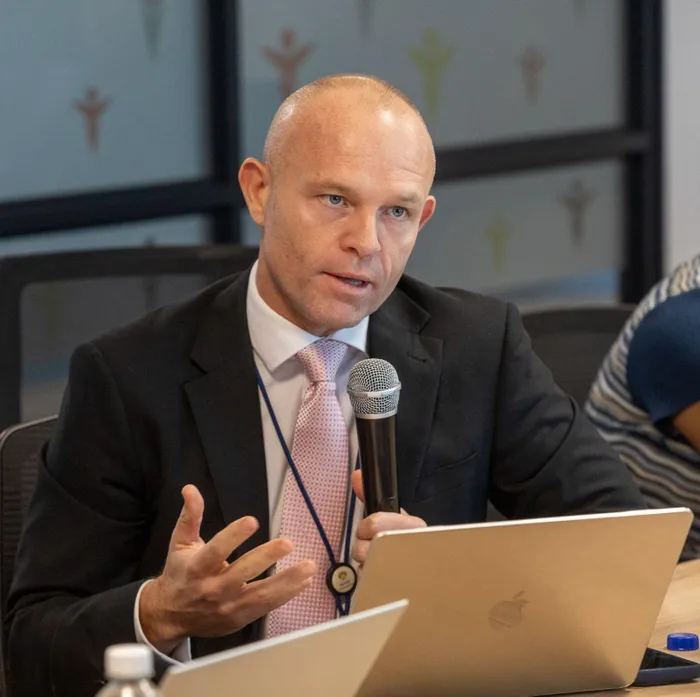
DA MP Nicholas Gotsell.
Image: Supplied
Criminologist expert Dr Jean Redpath said that the biggest structural reasons SAPS struggles to police areas like the Cape Flats effectively is due to the formula to allocate police resources,
Redpath explained: “What that formula ends up doing is that areas like Khayelitsha, Harare, Mitchells Plain actually get fewer resources per person than more formal areas. That is because those areas have relatively low reporting rates of crime.
“Instead of 80 or 90 percent of people reporting crime, 30 to 40 percent report crime. The crime data is used in the formula to allocate resources. So if an area has a low reporting rate, then it’s actually going to end up with low resources on a per person basis.”
She added that this has been seen within the Khayelitsha commission and Harare had the lowest allocation of resources of any police station in the Western Cape at the time.
Adjustments have been made to the formula following a court case, however Redpath said that it is still not enough to address the nature and type of crimes that occur on the Cape Flats.
She added that following the crime stats being released, most areas in the province and Cape Town have had a bad increase in murder, however in areas where LEAP officers are deployed were somewhat better off.
Redpath says: “That could be so much better if there was good cooperation between SAPS and LEAP officers, but SAPS is not using the LEAP officers and the resources of the metro police.
“They are not using them and properly working together with them. Another key problem is that those LEAP officers are seizing a lot of firearms which is a good thing. But those cases of people who had the firearms are simply not being prosecuted.”
She added that these cases often see excuses such as SAPS not doing the ballistics or other delays, but she believes that much more can be done to boost the process.
Furthermore, some attention should go to the prosecuting authority as it is of no use if SAPS make arrests if they are not convicted or have a criminal record.
Redpath added: “The whole system needs to improve and they really need to focus on firearms offences, preventative things, like dangerous weapons in public spaces who tend not to be prosecuted due to problems such as proving that it is a firearm.
“These things require applying the mind and trying to solve the problem which is not being done.
“Communities must ask that consequences follow when the police mess up or when they are not doing what they should be doing. If someone is incapable in their job, they should be incapacitated out of the job.”

Senior Researcher at the Dullah Omar Institute Dr Jean Redpath.
Image: Dullah Omar Institute
As crime rises and the festive season looms, Cape Flats residents remain caught between overstretched policing, national red tape, and the City’s push for devolution leaving their safety hanging in the balance.