PICK YOUR POISON - Experts warn public against illicit dop and how to spot a fake bottle
THE next time you decide to buy dop at the smokkie, be on the lookout, as fake alcohol is on the rise and being manufactured right under our noses, in our neighbourhoods and surrounding areas.
Police have clamped down on multiple illicit manufacturing and distribution of alcohol in Cape Town.
Police confirmed that on 27 January 2026, members of Kraaifontein Crime Intelligence stumbled upon an illegal alcohol manufacturing plant in Antelope Street, Uitzicht.
The members were on a mission to recover an unlicensed firearm and were looking for a person of interest believed to be at the mentioned address.
At approximately 10.30pm, they descended at the premises where they found two Congolese nationals aged 23 and 24. While searching, members uncovered large quantities of alcohol as well as manufacturing machinery in one of the rooms. The two males were arrested on the spot for illegal manufacturing of alcohol.
On Wednesday, 3 December 2025, Lingelethu West policing precinct confiscated illicit liquor in Spine Road.
Members of Lingelethu West SAPS were conducting a roadblock on Spine Road, Khayelitsha, when they stopped a silver Hyundai I20 and searched the vehicle. The members found four boxes containing Old Buck Gin in the vehicle and the occupants could not give an account for the liquor in the vehicle.
Further investigation led the members to a premises in Lansdowne where they found an illegal alcohol manufacturing plant and manufacturing equipment, an assortment of alcohol branding stickers and unknown liquids.
Two suspects, aged 26 and 39, are facing charges for the illegal manufacturing and distribution of liquor.
It does not stop there, on Thursday, 2 October 2025, members of Operation Shanela II in the Western Cape followed up on information about a facility illegally manufacturing and distributing alcohol.
The members descended on a farm located in Faure, Stellenbosch, where they uncovered a fully operational illegal alcohol manufacturing facility inside a building on the property.
The operation led to the arrest of five Malawian suspects, aged between 26 and 45, and the seizure of large quantities of illicit alcohol and manufacturing equipment.
Equipment used in the production of counterfeit or unregulated liquor was discovered and includes plastic containers filled with chemicals, hundreds of empty and pre-filled liquor bottles, industrial-grade bottling and capping machinery and boxes.
Upon further investigation, the members visited a storage facility in Woodstock, Cape Town, where a Chinese national aged 53 was arrested. A substantial quantity of illegal, pre-packaged alcohol was confiscated at the second location, suspected to be ready for distribution.
The networks are getting bigger and so is the market.

WARNING: Dr Simon Howell
Image: UCT
Dr Simon Howell, Senior Researcher at the Centre of Criminology at the University of Cape Town, explained: “The market for illicit alcohol is quite extensive and quite large.
“There are various historical reasons for its existence, but essentially, it’s a means of producing liquor and consuming alcohol in a manner that may be cheaper than a bar or liquor store. It is also a business for people who are making it.
“South Africa has extensive issues with alcohol and is one of the main drivers of violence, death and destruction. The illicit trade is unregulated, the alcohol which is produced is not tested or checked and may cause death or destruction.
“During Covid, people made pineapple beer which caused quite a few sicknesses because of what was in it. Alcohol is severely dangerous.”
A case from 2024 saw four farmworkers at Koelenhof, outside Stellenbosch, die from alcohol poisoning after drinking unregulated gin.
Cheap booze can feel like a lekker score before a memorable night. But it can be deadly.
When asked what would be the visual cues to look out for when spotting the real from the fake, Dr Howell said the difference would be around the bottles, the quality of the labelling like are they made from paper or sticky paper, does the label come off easily, are the bottle caps sealed properly and do they look the same and are there any marks on the bottle.
Howell added: “There may be replicas of the thing they are trying to imitate, but there will always be a lack in quality or a lack in which things were done, such as blurred stickers or badly pasted stickers.
“There are long-term health effects that are significant whether it is licit alcohol or illicit alcohol, and range from various forms of cancer, various forms of kidney destruction, liver destruction and alcohol takes a significant toll on the body.
“At the moment, there are a lot of efforts being made to replicate legitimate forms of alcohol, but this changes quite frequently. A lot of the modern illicit trade has its roots in Covid in the prohibition.
“That, of course, was the worst thing to do with alcohol and alcohol related matters and has been shown time and again for the last hundred years. Prohibition does not work and creates a market that makes it worse and harder to deal with.
“The things that are illicit might not necessarily be counterfeit, such as pineapple beer; it is not aiming to be something else, it is just illicit because it is made in an unrelated manner.
“In terms of counterfeiting, it is typically mid-range alcohol, such as Smirnoff, Russian Bear, Johnny Walker Blue Label, there are not too many fakes of the high-cost alcohol because they are more difficult to replicate and imitate and have high levels of security measures.
“Equally, you don’t want to replicate or counterfeit things that are low value because it is not worth your time or effort, as you don’t generate enough income.
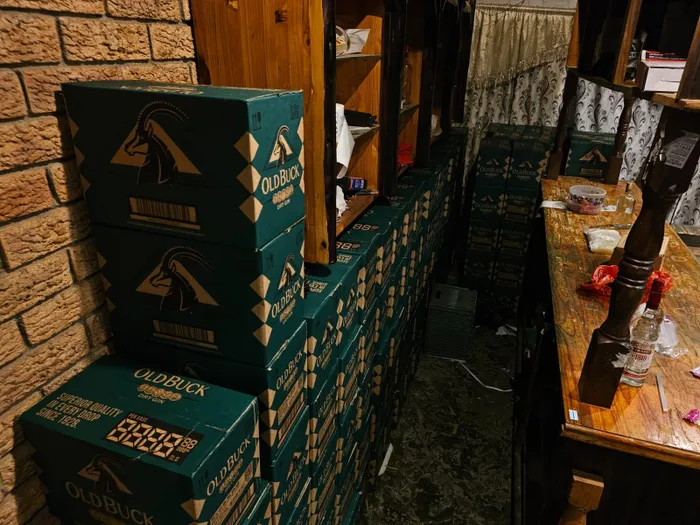
ON THE RISE: Boxes of counterfeit booze
Image: Supplied