THAT'S BASIC EDUCATION - Know your rights about your child's right to schooling
BACK TO SCHOOL: Kids have a right to a Constitutional right to a basic education
Image: Karen Sandison
THE right to a basic education is enshrined in the Constitution of South Africa, but every January we hear how mense sukkel just to get their children into a school.
From late applications and disappointing school placements to report cards being withheld… let’s get to the basic knowledge on your rights.
Parliament’s Portfolio Committee on Basic Education has received complaints that some schools are unlawfully withholding learners’ academic report cards and placing financial pressure on parents at no-fee schools.
It was also reported that reports are being withheld from learners whose parents could not participate in fundraising activities due to economic hardships.
Here in the Western Cape, no-fee schools refers to public schools in low-income areas (Quintiles 1-3) which receive government funding instead of charging compulsory school fees, though they can request voluntary donations.
These schools are managed by the provincial education department (WCED) in the province.
The key characteristics of no-fee schools are:
- These are Quintile 1, 2, and 3 schools, designated for disadvantaged communities.
- Learners at these schools do not pay mandatory school fees, including registration fees, as per the South African Schools Act (SASA).
- They rely on government funding (Non-Personnel/Non-School Fees) for operational costs. Schools can still request voluntary donations or hold fundraisers.
The Chairperson of Parliament’s Portfolio Committee on Basic Education, Joy Maimela, also noted growing complaints and social media reports indicating that parents at no-fee schools were being required to purchase stationery.
She described the process as unlawful and a direct violation of learners’ constitutional right to basic education, saying: “Government makes provision for learner teacher support material (LTSM), including stationery, at no-fee paying schools.
“School Governing Boards (SGBs) or school managements can therefore not implement new measures that are in conflict with legislation, regulations and policies.”
She also stated that participation in fundraising initiatives at schools is voluntary and that learners must not be punished or discriminated against because of their parents’ socio-economic circumstances.
The Department of Basic Education (DBE) has repeatedly emphasised that public schools (fee paying and non-fee paying) are not allowed to withhold academic reports, certificates, transfers or any other documentation as a means of enforcing payment of school fees.
However, independent/private schools are governed by contract law, and their ability to withhold reports depends on the specific terms of the agreement between the school and the parents.
All of this being said, with schools re-opening this week, there are still pupils awaiting results and transfers because of non-issuing of reports (by the school and SGB) for non-payment of school fees.
Non-placement of pupils in the Western Cape also remains a huge problem. Cosatu Western Cape Provincial Secretary Malvern de Bruyn said: “Year after year, we don’t see any plans from the department that work to address the issues faced by learners and parents.
“Kids are not placed in schools and end up staying at home for a full year, and then the department shifts the blame to parents.”
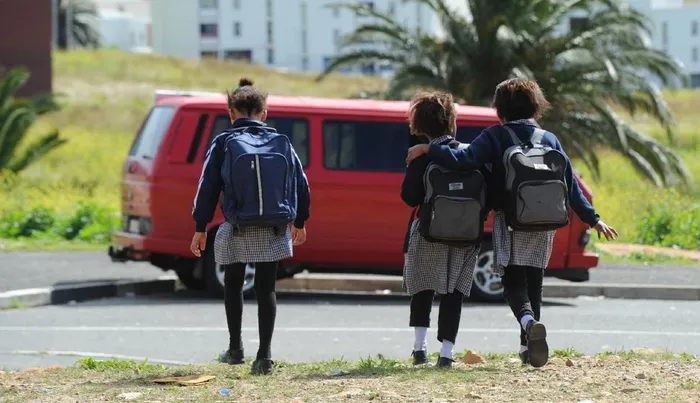
NEVER TOO LATE: A total of 5 873 new late applications were received in November, 4 035 in December and 758 “new extremely” late applications from the beginning of the month up to January 7.
Image: Henk Kruger/Independent Newspapers
The WCED has stated that late applications continue to affect placement progress. Since 1 November 2025, the WCED has received 10 666 new late applications (5 873 in November, 4035 in December and 758 extremely late applications in January).
Most of these children still need to be placed by the time the 2026 school year opened.
What about the children who have not been placed at a school of their parents’ choice, or within their travelling vicinity?
Cosatu has also voiced their concern at the inequality across the provincial schooling system, saying that the challenges of overcrowding remain concentrated in black and coloured working-class communities.
De Bruyn added: “When we visit Model C schools in affluent areas, classrooms typically accommodate about 30 learners. But in black and coloured areas, you find classrooms with more than 60 learners in one classroom.”
On 9 January 2026, the WCED posted on their Facebook page that their staff would be available at selected centres on Saturday 10 and 17 January from 9am to 3pm, to assist with 2026 admission applications.
They reminded the public to bring along necessary documentation, namely certified copies of the following documents:
Identity document (ID) or birth certificate of the learner and parent/caregiver;
If a foreign learner: a passport or a copy of parent’s refugee or asylum seeker permit on which the learner’s name should appear;
If the learner has foreign parents but was born in South Africa: a handwritten birth certificate (DHA 19 form); and parent/caregiver identification or
If the learner was not born in South Africa: a passport or a refugee or asylum seeker permit issued in the learner’s name and parent/caregiver identification.
Immunisation card / Road to Health chart (pre-primary and primary schools only)
The latest official school / academic report of the learner
Proof of residence e.g. rates account / lease agreement / an affidavit made at a police station confirming residence.
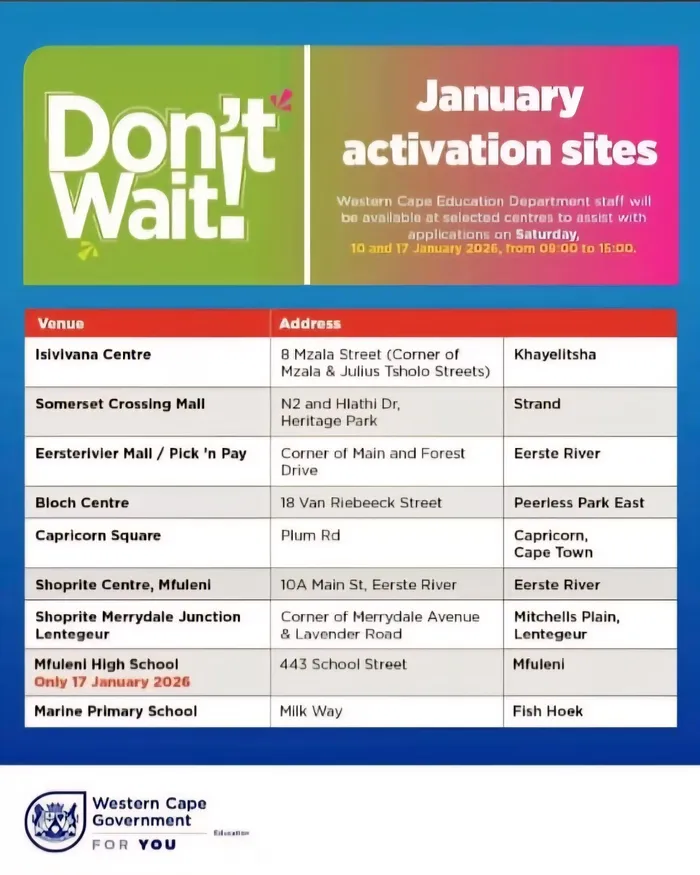
LAST CALL: WCED host activation sites for late applications
Image: Supplied